How do you run a hydraulic simulation of a drinking water network?
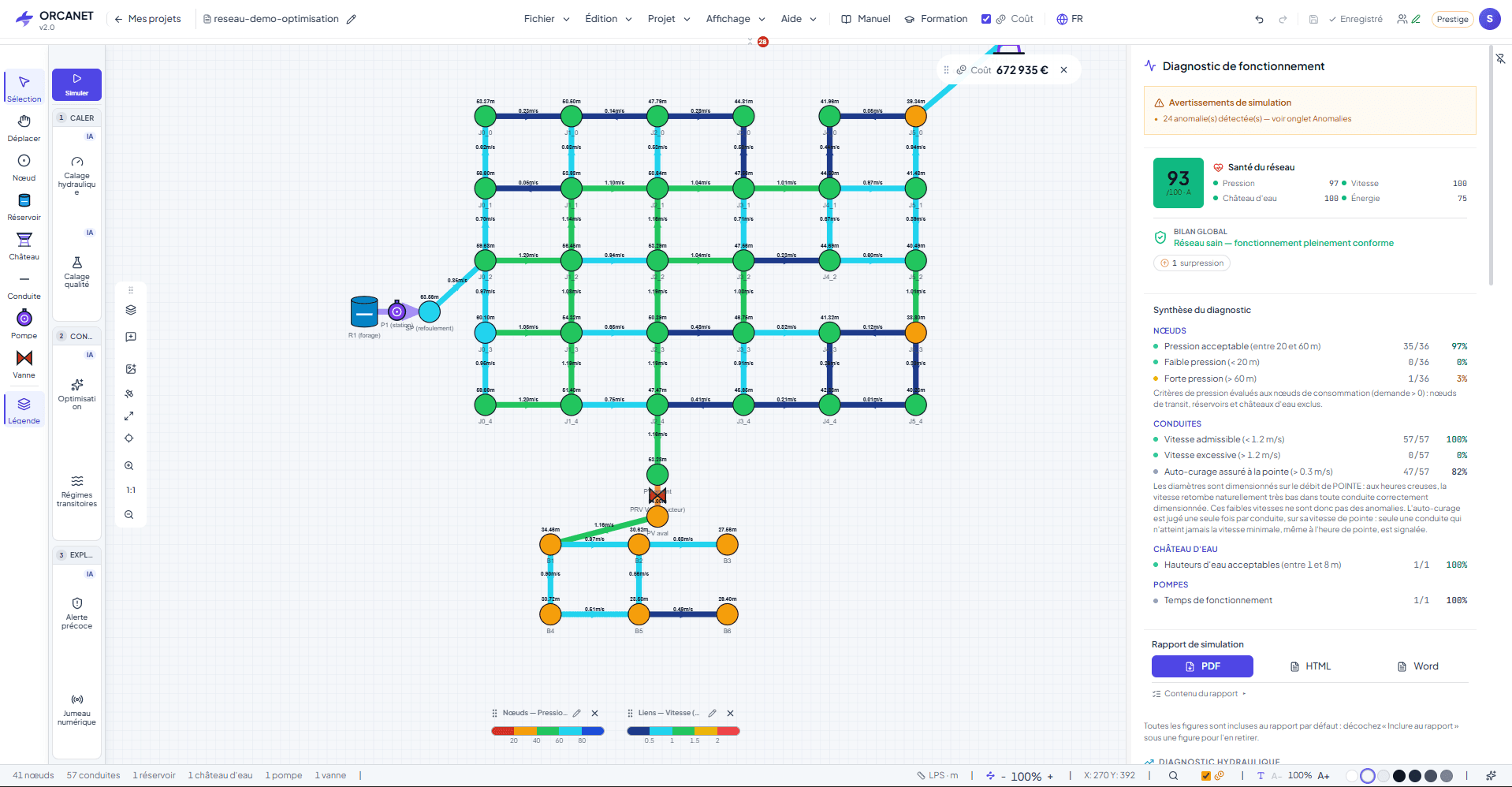
Import your network (EPANET .inp file) or draw it over a map, enter demands and elevations, then run the calculation. ORCANET solves the hydraulic balance with the global gradient method — the same basis as the field standard — and returns pressures, flows, velocities and head losses in seconds, as a snapshot or over 24 hours.
Which hydraulic modelling software for drinking water?
ORCANET is a web platform: nothing to install, nothing to update, and the model stays reachable from any workstation. It covers modelling, calibration against field measurements, water quality, least-cost sizing and transient regimes — tasks that until now required several separate programs.
How do you size a water supply network at least cost?
The optimisation module searches for the cheapest combination of diameters that satisfies your constraints: minimum pressure at every node, maximum velocity in every pipe, and a catalogue of diameters actually available. On the case-study networks, the reduction in laying cost ranges from 28% to over 60% compared with sound manual sizing.
Can you analyse an existing water distribution network?
Yes, and it is the most common starting point. Import the existing model, calibrate it automatically against your pressure and flow readings, then test scenarios: extension, burst, fire flow, peak demand. Calibration adjusts roughness and demands so the model reproduces what the field measures.
Is ORCANET compatible with EPANET?
Yes. .inp files import and export, and the steady-state solver uses the global gradient formulation: on the same network, results are comparable. You keep your existing models, and what ORCANET adds — optimisation, automatic calibration, digital twin, water hammer — comes on top.
How do you compute water hammer on a pressurised network?
The transient module solves the equations with the method of characteristics: pump trip, valve closure, start-up. It returns the envelope of extreme pressures along the route, compares the maximum head with the pipes' nominal pressure, and sizes protections (air vessel, surge tank, relief valve) by comparing their cost.